
Anrong Credit Rating Invited to Attend the Working Meeting on Promoting China’s Independent Knowledge System for Asset Valuation and the Professional Doctoral Degree Program
On 31 May, Dr Zhou Yuanfan, Chief Economist of Anrong Credit Rating Co., Ltd. and Chairman of the Board of Anrong (Hong Kong) Credit Ratings Co., Ltd., attended the Working Meeting on Promoting China’s Independent Knowledge System for Asset Valuation and the Professional Doctoral Degree Program, organised by the National Teaching Steering Committee for Professional Master’s Degree Programs in Asset Valuation (hereinafter referred to as the “Teaching Steering Committee”). Dr Zhou was the only invited expert from the credit rating field. The meeting was held at the Central University of Finance and Economics. Attendees included Ma Haitao, Deputy Director of the Teaching Steering Committee, Deputy Party Secretary and President of the Central University of Finance and Economics; Lu Qingping, Deputy Director of the Teaching Steering Committee; Yao Lingzhen, Member of the Party Committee and Vice President of Shanghai University of Finance and Economics and a member of the Teaching Steering Committee; and members of the Teaching Steering Committee Zhang Genghua and Yang Songtang, among others. Leaders from the China Appraisal Society, renowned scholars from universities, and leading experts from valuation institutions gathered to hold in-depth discussions on two core topics: the development of the textbook system for “China’s Asset Valuation Studies” and the application to the doctoral degree programme in asset valuation. The meeting was chaired by Li Xiaorong, Secretary-General of the Teaching Steering Committee and Deputy Dean of the School of Public Finance and Taxation at the Central University of Finance and Economics.
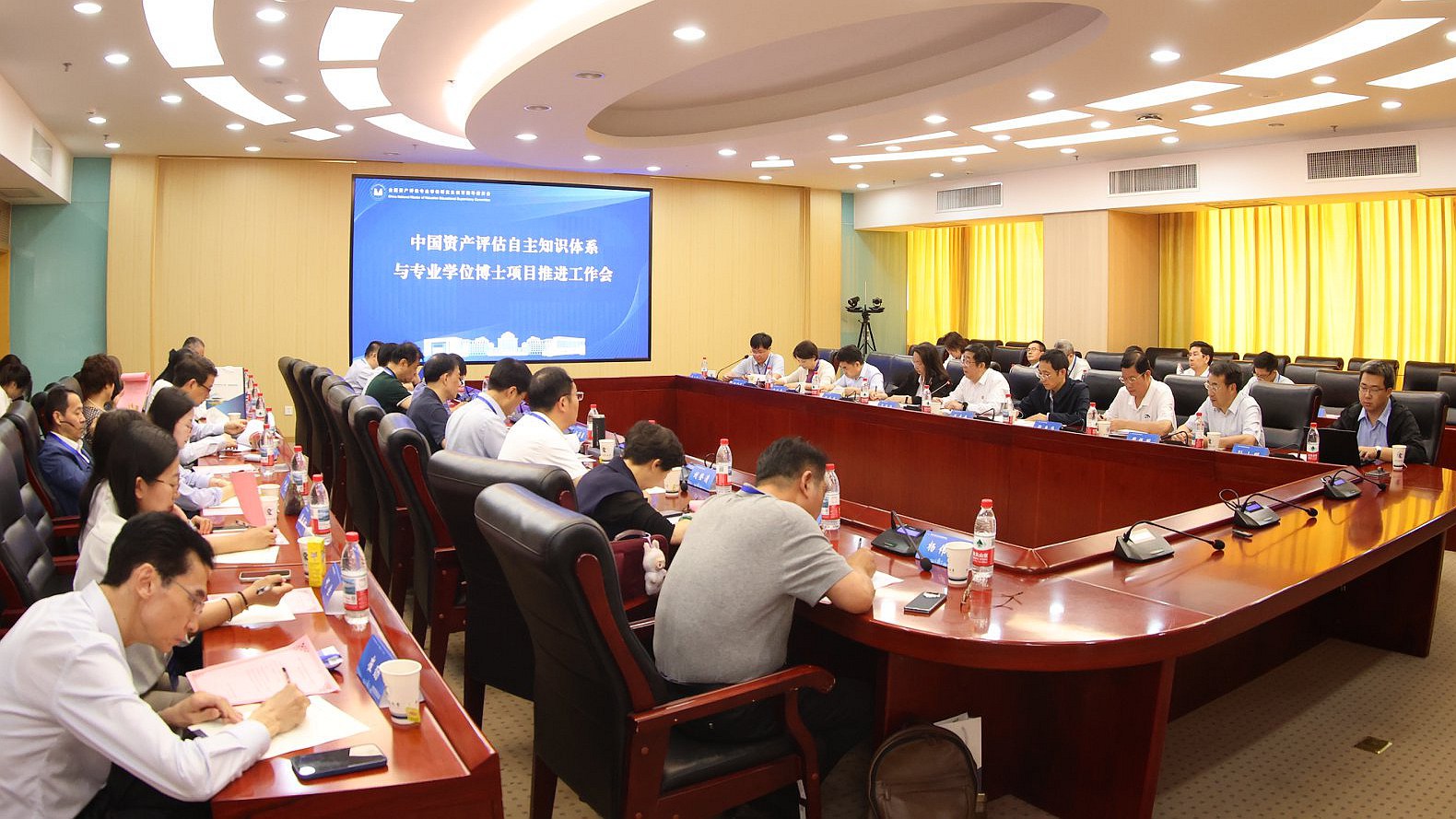
Experts at the meeting stated that “China’s Asset Valuation Studies” is an important vehicle for building an independent knowledge system for asset valuation in China. It will systematically distil more than 30 years of domestic asset valuation practice, address shortcomings in existing textbooks regarding theoretical innovation and local characteristics, integrate multi-level teaching across undergraduate and postgraduate programmes, and promote the standardised development of the discipline. They suggested that textbook development should closely align with the “China” core and disciplinary rationality, and be structured around three main sections: macro foundations, practical content, and supervision, education & international comparison. Across the dimensions of theory, practice, and regulation, it should summarise local experience, refine distinctive theories and methods, break through the limitations of traditional valuation theories, and emphasise systematisation, independence, and completeness, while also meeting the needs of undergraduate, postgraduate, and cross-disciplinary learners, to create an authoritative textbook highlighting Chinese characteristics. At the same time, experts proposed accelerating the application process for the professional doctoral programme in asset valuation to address shortcomings in the cultivation of high-level talent.
The professional doctoral education in asset valuation is designed for outstanding talent in government regulatory departments, enterprises, public institutions, and professional organisations who have extensive practical experience and significant professional achievements in asset valuation–related fields. It aims to cultivate high-calibre, application-oriented, and internationalised asset valuation professionals who not only possess a solid theoretical foundation and cutting-edge research capabilities in asset valuation but are also familiar with valuation practice, have an international perspective and strategic leadership, and can creatively study and solve complex problems in asset valuation practice.