
“How Can Data Become a Credit Basis Recognised by Financial Institutions?” — Xinhua Finance Publishes Dr Zhou Yuanfan’s Key Views Delivered at the Northeast Asia Financial Conference
On September 10, Xinhua Finance published an article titled Experts Discuss How “Industrial Internet + Fintech” Can Empower the Transformation of Old Industrial Bases. The article excerpted key views expressed by Dr Zhou Yuanfan, Chief Economist of Anrong Credit Rating Co., Ltd. and Chairman of the Board of Anrong (Hong Kong) Credit Ratings Co., Ltd., at the 4th Northeast Asia Financial Conference in 2026, on the topic of “How can data become a credit basis recognized by financial institutions?”
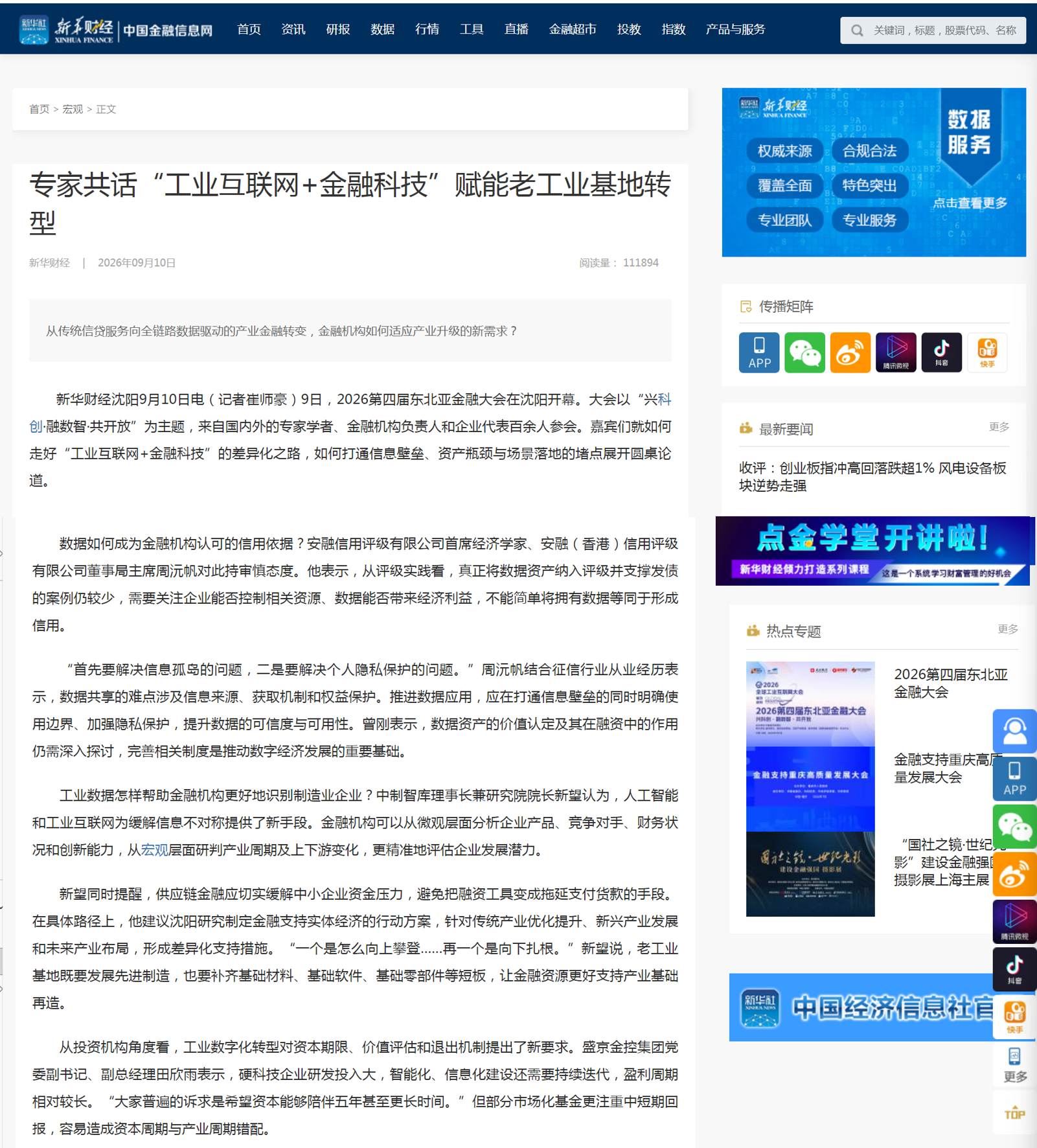
Against the backdrop of the accelerating integration of the digital economy and the real economy, whether industrial data can be transformed into credit assets recognised by financial institutions has become a shared concern of both industry and the financial sector. From the professional perspective of a rating agency, Dr Zhou Yuanfan provided a prudent and in-depth analysis of the practical challenges and feasible pathways for creditizing data assets. Dr Zhou noted that the market currently has certain misconceptions regarding the credit value of data assets. It is urgently necessary to return to the fundamentals of credit ratings and clarify the logic by which data is transformed from a “resource” into an “asset” and then into “credit.”
In recent years, with the widespread deployment of industrial internet platforms, manufacturing enterprises have accumulated massive volumes of equipment operation data, supply chain coordination data, and energy consumption monitoring data during their production and business activities. Many have hoped this data could replace traditional collateral and guarantees and become a “new credit credential” for small and medium-sized enterprises to obtain financing. However, based on credit rating industry practices, the creditization of data assets is far from as simple as “having data means being able to obtain financing.” Dr Zhou emphasised that when evaluating data assets, rating agencies must look beyond appearances and return to the essence, focusing on two core requirements: first, an enterprise’s actual ability to control the relevant data resources; and second, whether the data can continuously and steadily generate quantifiable economic benefits for the enterprise. Only when both conditions are met can data potentially be included within the scope of credit rating considerations.
How can data become a credit basis recognised by financial institutions? Dr Zhou Yuanfan takes a prudent view of this issue. He said that, based on rating practices, relatively few cases have genuinely incorporated data assets into ratings and used them to support bond issuance. Attention must be paid to whether enterprises can control the relevant resources and whether the data can generate economic benefits. Simply possessing data does not equate to established creditworthiness.
Dr Zhou’s prudent position reflects the rating industry’s core principle that substance takes precedence over form. Amid the enthusiasm surrounding data assets, the market can easily fall into the misconception that “data abundance means strong creditworthiness,” overlooking key links such as data rights confirmation, data governance, and monetising data value. In fact, no matter how much data an enterprise possesses, without clear ownership definitions, sound governance structures, and mature business models, that data is at best a dormant resource. It is difficult to transform it into credit support that financial institutions are willing to rely on and that rating agencies can quantify. Dr Zhou’s reminder provides a much-needed dose of sobriety for the current, somewhat impetuous process of data assetization, while also identifying the necessary prerequisites and feasible boundaries for policymakers and market participants seeking to creditize data.
Having clarified the basic prerequisites for the creditization of data assets, Dr Zhou further drew on professional experience in the credit reporting industry to identify two institutional bottlenecks constraining the release of the financial value of data assets. He believes that for data to truly serve credit assessments and financial decision-making, a delicate balance must be achieved between breaking down information barriers and safeguarding the bottom line of privacy. This judgment is rooted both in the practical challenges of China’s credit reporting system and in the leading global trend in data governance of “usable but invisible” data:
“First, the issue of information silos must be addressed; second, the issue of personal privacy protection must be resolved.” Drawing on his professional experience in the credit reporting industry, Dr Zhou stated that the difficulties of data sharing involve information sources, acquisition mechanisms, and the protection of rights and interests. To advance data applications, it is necessary to clarify boundaries of use and strengthen privacy protection while breaking down information barriers, thereby enhancing data credibility and usability.
Dr Zhou’s discussion precisely captures the “one body, two wings” of data asset creditization. Information silos make it difficult for financial institutions to obtain comprehensive, continuous, and reliable enterprise operating data, so credit assessments often rely on limited financial statements and collateral information. This makes it impossible to fully reflect the actual operating capacity and growth potential of manufacturing enterprises. At the same time, inadequate privacy protection erodes the social foundation for data sharing, fueling concerns among enterprises and individuals over data misuse and ultimately creating a deadlock in which parties “dare not share and are unwilling to share.” Therefore, advancing the creditization of data assets is not merely a technical issue. It is a systematic undertaking involving institutional design, legal safeguards, industry self-regulation, and technological empowerment. Only by clearly defining data ownership, regulating boundaries of use, and strengthening privacy protection can industrial data truly move from “information silos” to “credit pathways,” transforming from dormant means of production into active financial factors.
As a professional institution deeply engaged in the credit rating field, Anrong Rating has consistently adhered to prudent, independent, and professional practices. Dr Zhou Yuanfan’s remarks at the 4th Northeast Asia Financial Conference not only demonstrated Anrong Rating’s in-depth thinking on frontier issues related to the creditization of data assets, but also highlighted rating agencies' responsibility to guide market expectations, prevent financial risks, and serve the real economy. Looking ahead, Anrong Rating will continue to monitor institutional developments in data asset rights confirmation, valuation, and creditization; actively participate in the development of rules for the data factor market; and use its professional rating methodologies and extensive practical experience to provide solid credit infrastructure for the deep integration of the industrial internet and fintech, helping China’s manufacturing sector achieve steady and sustained digital transformation.